Well 2I
Horizontal well at 90° — the most challenging profile on the project, 3,200 m reach. FRS-89 in open hole let the team skip the oscillator and reach TD 3,600 m.
Well profile
Project goals
- 01
Drill horizontal with a mud motor, no oscillator
- 02
Maximum horizontal displacement (HD) to target
- 03
Beat the calculated torque limit of 29–30 kN·m (close to make-up torque)
- 04
Reduce hook load on POOH
Technology
FRS
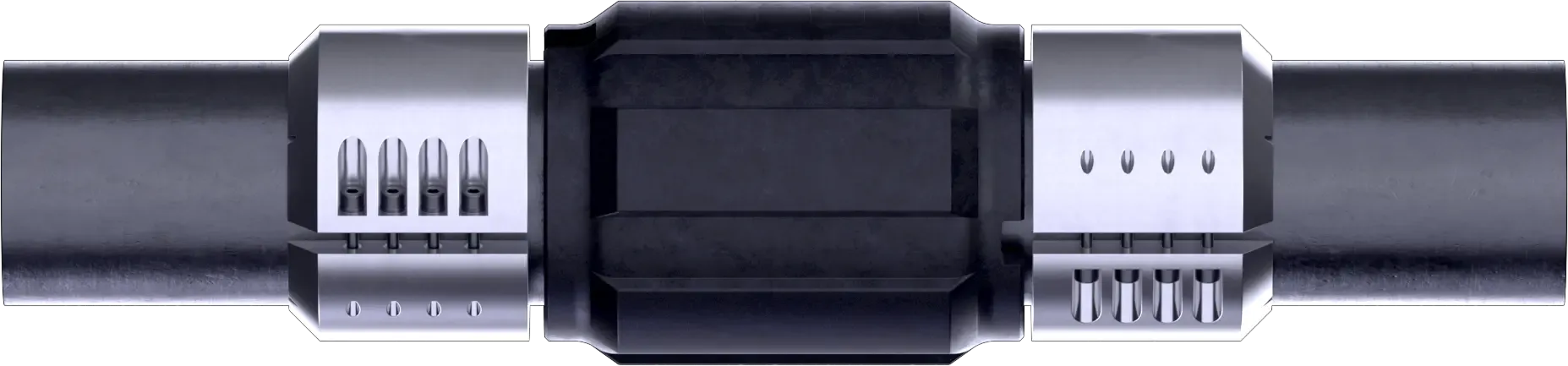
Frameless composite friction reducers. Installed on the drill pipe in zones of maximum side load. The pipe rotates inside a stationary composite sleeve pressed against the wellbore wall.
Plain-bearing principle
The drill pipe rotates inside a stationary composite sleeve. The sleeve is pressed against the wellbore wall or casing by lateral load — never touching the pipe body.
Friction coefficient < 0.06
Low-friction composite — Kompozit №1. For reference: steel on steel runs at 0.13 in the lab. 2×+ less friction.
1–2 min to install
Mounts on the pipe during a trip or on the catwalk. Held by two stop collars. No steel frame, no hinges inside the sleeve.
Key results
Conclusions and lessons
- 01
Oscillator dropped
DoneWithout FRS, torque would have run at 29–30 kN·m — right up against make-up torque. Rotary drilling would have been capped. With FRS, rotary drilling ran unconstrained.
- 02
Torque trend
DoneActual torque tracks the FRS-aware forecast curve. Trend break visible at 3,800 m — from rising to flat.
- 03
FRS working — confirmed
DoneWear marks on the pipe prove FRS is working: the pipe rotates inside a stationary sleeve.
We build FRS to your project conditions
We design and supply friction reduction systems for drilling. Tools are engineered for real well conditions and run as part of an engineering plan.
We run T&D — we don't guess
We work through the well data, constraints, and risks. The output: a configuration you can defend and a clear plan for the run.
We're on the rig with you
We support the project on site — align the run scenario, tune parameters, capture the result, and roll the learnings into the next well.

Run the numbers on your well
Send your well data and constraints — we'll run T&D modeling and come back with a configuration and the expected impact.